When an agent starts producing worse outputs, the default attribution is the model. The model changed. The model got worse on long contexts. The model forgot what it knew between sessions. This framing is understandable: the model is the named thing, the thing with a version number, the thing that ships with release notes.
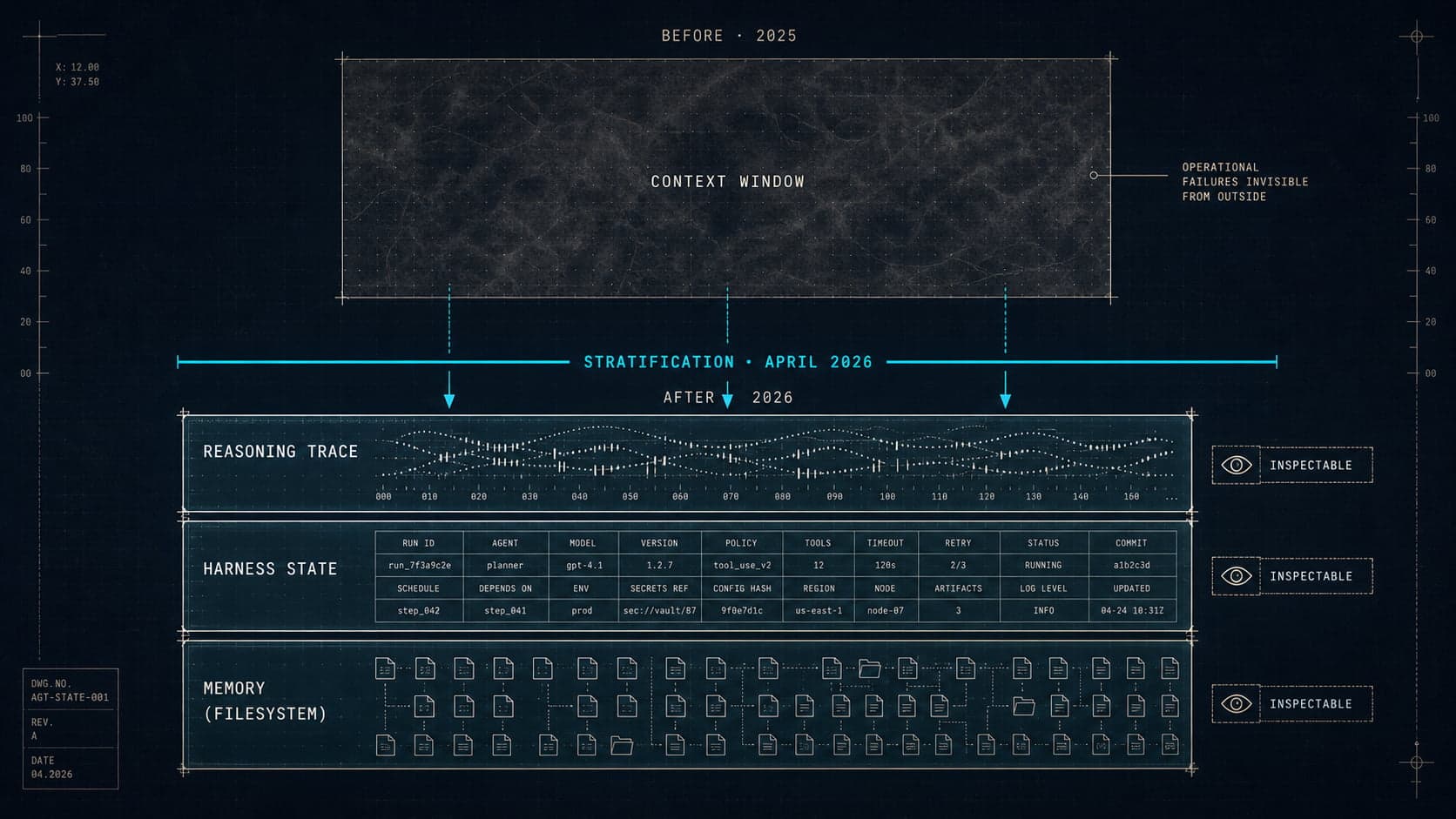
Three signals from April 2026 converge on a different answer. The failure usually lives in the cognitive state layer beneath the model. That layer used to be treated as a single opaque thing — the context window. April 2026 showed it stratifying into three named, separately inspectable sub-layers. The stratification is not cosmetic. It changes where teams need to look, what they need to instrument, and which failures are attributable to which part of their stack.
The three signals are: a paper on reasoning trace compression under context load (arXiv:2604.01161, April 1), the Anthropic Claude Code postmortem on two months of harness-sourced regressions attributed to the model (April 24), and a cross-vendor convergence on filesystem-as-agent-memory that shipped across Anthropic, OpenAI, Google, and five-plus open-source repositories in the same thirty-day window (April 17 through 23). None of the three signals is about model weights. All three are about the structures that wrap and feed the model. Together, they name a layer that previously had no agreed vocabulary.
The Three Sub-Layers
The cognitive state layer has separated into three named sub-layers, each of which became inspectable for the first time in April 2026. The names are not standardized yet across the industry. But the functions are distinct enough that conflating them produces the misattribution problem this piece is about.
The first sub-layer is the reasoning trace: the working memory of a reasoning model's intermediate thinking. It is the chain of deliberation a model produces before committing to an output. It has always existed inside the context window, but until recently it was not separately logged, monitored, or attributed as its own failure surface. The Reasoning Shift paper is the first systematic treatment of how this sub-layer degrades independently of output quality.
The second sub-layer is the harness state: the system prompts, memory management logic, retry behavior, and tool routing that wraps the model and constructs what it sees on each turn. The harness is not the model. It is operator-controlled code. It ships on a different cadence than model weights. It can be buggy in ways that are invisible at the output layer. The Anthropic postmortem demonstrated that two months of perceived model regression traced entirely to harness bugs, with the model weights unchanged throughout.
The third sub-layer is the memory layer: the persistent state that survives across sessions. This is the piece of agent state that has historically been the most opaque — buried in vector embedding space, retrievable only probabilistically, and not inspectable by operators in any direct sense. The April convergence on filesystem-as-agent-memory is the industry beginning to treat this sub-layer as structured data rather than statistical noise.
Each of these three sub-layers was traditionally invisible inside the context window. Each separately had its moment of clarification in April 2026. Together, they constitute the operational surface where agent reliability now lives — and where most agent debugging currently does not look.
The Reasoning Trace
Rodionov published "Reasoning Shift: How Context Silently Shortens LLM Reasoning" on April 1, 2026 (arXiv:2604.01161). The paper is not about models producing wrong answers. It is about models producing confident answers after compressing their reasoning traces by up to 50 percent under specific context conditions. Three conditions trigger the compression: lengthy irrelevant context in the prompt, multi-turn conversations with independent tasks, and problem-as-subtask framing where the question is embedded inside a larger request.
The compression is selective. It does not distribute randomly across the trace. The first behavior to disappear is self-verification: the intermediate steps where the model audits its own reasoning, checks for contradictions, and reconsiders its approach before committing to an answer. Under context load, those steps compress away while the model's surface confidence is unchanged. Same model. Same output structure. No self-audit.
The cross-domain bridge here is precise, not analogical. Peng et al. (2021) documented an equivalent phenomenon in cognitive psychology: under divided attention, humans preserve metacognitive monitoring (the awareness that they should double-check their work) but lose metacognitive control (the capacity to actually execute the double-check). The monitoring and the control dissociate. In the Reasoning Shift data, the LLM equivalent is the same dissociation. The model's output structure still looks like careful reasoning. The verification loop that was supposed to execute within that structure has already been compressed out.
The operational implication: for long-horizon agent tasks, output correctness is a lagging indicator. The reasoning trace is the leading indicator. A trace that shows no self-verification steps on a hard subproblem is a warning signal regardless of whether the output looks correct. The failure is invisible until the problem is hard enough that self-verification was load-bearing — at which point the answer is already committed.
The reasoning trace sub-layer is what makes this inspectable. Without separately logging trace content, teams have no visibility into whether the verification loop executed. Output-level evaluation cannot detect this failure mode. The trace can.
The Harness State
On April 24, 2026, Anthropic published a postmortem on the Claude Code harness. The document explained two months of "Claude got worse" complaints from users. The explanation was not a model regression. Three harness bugs were responsible, each affecting a different aspect of how the harness constructed and managed the context the model received on each turn.
The most consequential bug: a thinking-trace-clearing change shipped on March 26 was supposed to run once after one hour of session idle time. A bug caused it to fire on every turn instead. The model's working memory was being wiped at the start of each turn, invisibly, for the duration of the session. Users experienced an agent that appeared to forget context, repeat itself, and reason with reduced depth. The model weights were unchanged throughout. The harness was destroying the model's state on a loop.
The structural lesson from this postmortem is about cadence asymmetry. Model weights ship on a quarterly-or-longer cadence. Harnesses ship weekly, sometimes daily. The harness is where context construction, memory management, retry logic, tool routing, and recovery behavior live. It is the component of the cognitive state layer that changes most frequently. It is also the component most teams treat as plumbing rather than as a first-class reliability surface.
Most agent quality dashboards track output correctness on eval sets and compare it against a model version baseline. This produces a diagnostic gap: it can detect model regressions but is structurally blind to harness regressions, because the harness wraps the model before the eval sees anything. A harness bug that corrupts context construction will register as model degradation on any evaluation framework that does not separately log and attribute harness state. The Anthropic postmortem is a documented case of a production team operating in exactly this gap for two months.
The harness state is inspectable in principle. The harness is code the operator wrote and can read. But it is only attributable as a failure layer if it is separately versioned, logged, and treated as a distinct diagnostic surface from the model it wraps. When those practices are absent, harness regressions get filed under model regression. The Anthropic team spent two months before the attribution was corrected.
The Memory Layer
The third convergence happened across multiple organizations simultaneously. On April 17, Google shipped Vertex AI Cross-Corpus Retrieval. On April 23, Anthropic released persistent file-system memory for Managed Agents. On April 23, OpenAI shipped GPT-5.5 Skills with file-system read and write capabilities across sessions. In the same thirty-day window, five-plus open-source repositories converged on the same underlying primitive under different names: Loom's "schema call protocol," Ctxo's "logic slices," Context Capsule, ContextWeaver, and related projects.
The vocabulary differs. The primitive is identical. Agents are moving their durable working state out of ephemeral context and into structured files that an operator can read directly. This is not a retrieval architecture change. It is a memory substrate migration. The thing the agent thinks with across sessions is becoming something a human can open in a text editor.
Vector databases are not disappearing in this architecture. They are being demoted. The vector store becomes a retrieval primitive underneath an inspectable filesystem, rather than the primary memory abstraction. Fuzzy semantic recall remains a job for vector search. Durable state, working context, and session-to-session continuity move into structured files. The operator can read the agent's memory directly. The agent's memory can be diffed, versioned, and audited.
The reliability argument for this architecture follows directly from the harness postmortem. When an operator cannot read the agent's state, the operator cannot debug failures that originate in that state. The four-year experiment of putting agent memory in opaque embedding space ran into the same wall every opaque-state architecture encounters: state corruption and retrieval failures are unattributable without readable state. Filesystem-as-agent-memory solves the attribution problem first and the retrieval problem second.
Building the Instrumentation
The three sub-layers are now named. The practical question is what to do with that. The answer is instrumentation: building the tooling that lets teams distinguish failures in the cognitive state layer from failures in the model itself. Without that instrumentation, every agent regression gets attributed to the most visible named thing, which is the model.
Six moves accomplish this in roughly increasing cost order. None of them requires access to model internals. All of them operate on the operator-controlled surface.
1. Pin a dated model snapshot, not the alias.
Anthropic publishes specific dated versions: claude-sonnet-4-5-20250929 is a concrete example of the format. Calling the model alias means the underlying weights can shift under a production system without any change to the calling code. With a dated snapshot pinned, the model is provably constant across any given time window. Every regression that appears after a harness change or memory update is now provably in the cognitive state layer, not the weights, because the weights did not change. This is the cheapest isolation step available and the prerequisite for everything else.
2. Run a bare-model eval suite on a schedule.
Build a small fixed battery — fifty to two hundred prompts — that calls the model directly with no agent code wrapping it. No system prompt from the harness. No memory state injected. No tool routing. Run it daily, or on every harness deployment. If bare-model output quality holds steady while agent quality drops, the regression is in the cognitive state layer. The isolation takes five minutes instead of two months. If bare-model quality also drops, the model changed. That is the only scenario where the model is correctly attributed.
3. Track per-turn telemetry on trace tokens, not just output.
Log reasoning-trace token count, tool-call count, first-token latency, and total tokens per agent invocation. The Anthropic harness bug cleared the thinking trace on every turn. That failure mode is invisible on output-quality dashboards: the model still produces output. It jumps off a graph of trace-token-length-per-turn the moment that graph exists. The Reasoning Shift paper makes the same point from the model side: trace length is the leading indicator of self-verification failure. Output quality is the lagging indicator. You cannot see the leading indicator without per-turn trace telemetry.
4. Version the harness state on every turn.
Log the exact system prompt hash, tool schema hash, memory snapshot fingerprint, and message-construction logic version alongside every agent invocation. When a regression report arrives, the question is: what changed? With versioned harness state, the answer is a lookup, not an archaeological dig. The Anthropic team's two-month investigation compressed into identifying which commit introduced the trace-clearing bug and when it shipped. That compression requires the harness state to have been separately versioned and logged.
5. Run three-way replays on regression reports.
Capture full request-and-response pairs from production. When a complaint lands, replay the same request through three configurations: (a) current harness with current model snapshot, (b) current harness with the previous model snapshot, (c) previous harness with the current model snapshot. The configuration that produces the regressed output is the one responsible. This makes attribution from a regression report a structured debugging step rather than a judgment call. It requires both dated model snapshots (move 1) and versioned harness state (move 4) to be in place first.
6. A/B harness changes on the same fraction of traffic you use for model changes.
Most teams route a small traffic slice through new model versions before full rollout. Almost no teams apply the same practice to harness changes, because harness changes feel like "just code" rather than "model behavior." The Anthropic postmortem is the case against this distinction. Harness changes affect what the model sees, which determines what the model produces. A harness change that corrupts context construction has the same user-visible effect as a model regression. The practice of A/B testing harness changes on five to ten percent of traffic for forty-eight hours before full rollout is the operational habit that catches the Anthropic-class bug before two months of misattributed complaints accumulate.
Conclusion
The cognitive state layer is now operational reality, not a framing convenience. Three sub-layers, each with distinct failure modes, distinct inspection surfaces, and distinct attribution traps. The reasoning trace fails silently under context load, compressing away self-verification while output confidence stays flat. The harness state fails when it ships a bug that corrupts context construction, producing regressions that look like model degradation because no one is separately tracking harness state. The memory layer has spent four years in opaque vector space, making state corruption unattributable and failure debugging largely archaeological.
April 2026 gave each sub-layer a name, a case study, and an emerging industry response. The architectural shift this signals completes when teams stop treating agent regression as a model question by default and start instrumenting the layer they actually control.
The unit of agent debugging in 2026 is the trace, not the model.
Citations and Sources
arXiv Papers
- Rodionov, "Reasoning Shift: How Context Silently Shortens LLM Reasoning." arXiv:2604.01161. April 1, 2026.
- Peng et al., "Dividing attention impairs metacognitive control more than monitoring." Psychological Science. 2021.
Vendor Announcements and Postmortems
- Anthropic Claude Code Postmortem: three harness bugs accounting for two months of perceived model regression, including the thinking-trace-clearing bug (March 26 commit, fired every turn). April 24, 2026.
- Anthropic Managed Agents: persistent file-system memory release. April 23, 2026.
- OpenAI GPT-5.5 Skills: file-system read and write capabilities across sessions. April 23, 2026.
- Google Vertex AI Cross-Corpus Retrieval. April 17, 2026.
Open-Source Convergence (same 30-day window)
- Loom: "schema call protocol" (filesystem-as-agent-memory primitive). April 2026.
- Ctxo: "logic slices" (structured agent state files). April 2026.
- Context Capsule: session-persistent agent context. April 2026.
- ContextWeaver: structured context management. April 2026.
- Additional OSS repositories (5+ total) converging on filesystem-as-agent-memory under varied naming. April 2026.