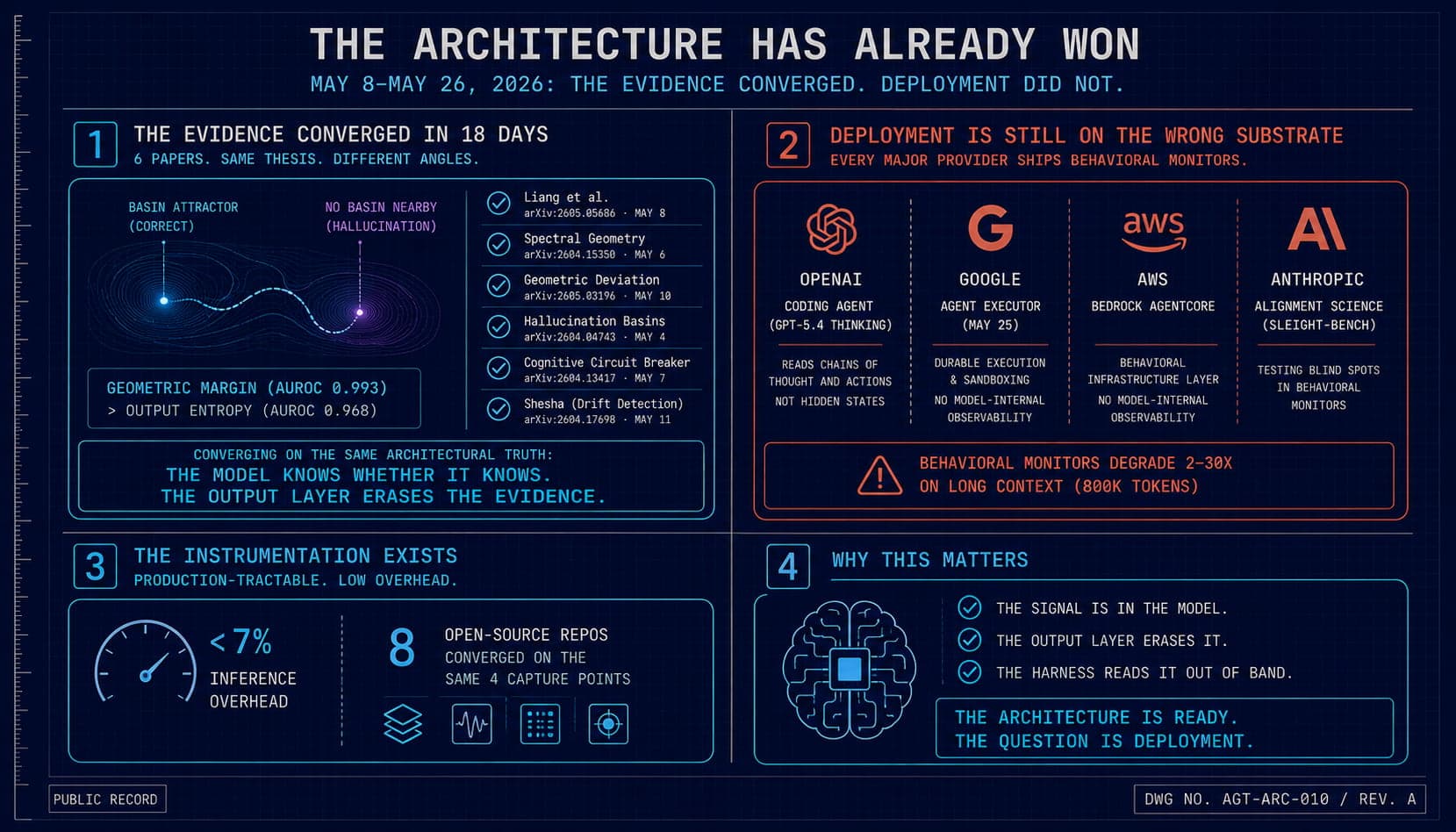
In the eighteen days since Liang, Miikkulainen, and Fiete published arXiv:2605.05686 on May 8, five more independent papers have measured variants of the same thesis: geometric hidden-state monitoring predicts hallucination before generation completes, and output entropy cannot. Three of those five papers ship production-tractable implementations. One of them, DMI-Lib (arXiv:2605.11093, May 11), is open-sourced and runs at less than 7 percent overhead in online serving. Eight independent open-source repos have converged on the same four hidden-state capture points without coordinating on vocabulary.
The architectural direction is no longer in dispute among researchers. The deployment direction is still wrong at every hyperscaler.
OpenAI's internal coding-agent monitor uses GPT-5.4 Thinking to read chains of thought and actions, not hidden states. Google's Agent Executor (May 25) focuses on durable execution and sandboxing with no model-internal observability. AWS Bedrock AgentCore is positioned in the same behavioral-infrastructure category. Anthropic's alignment science team released SLEIGHT-Bench on May 19 specifically to find blind spots in behavioral monitors, while the LessWrong "Classifier Context Rot" work (May 21) measured the substrate problem: frontier behavioral monitors degrade 2 to 30 times on long transcripts. Opus 4.6, GPT 5.4, and Gemini 3.1 all miss dangerous actions more often with 800K tokens of context prepended. The proposed fix is incremental monitoring, not a substrate switch.
What Did the Field Actually Measure in Eighteen Days?
Six papers in the May 8 to May 26 window have measured the geometric thesis from different methodological angles. They do not cite each other (most predate or postdate by days). They are not coordinated. They land in close formation because the underlying mechanism is converging on the same architectural claim.
The anchor paper is Liang, Miikkulainen, and Fiete (arXiv:2605.05686, May 8). The distance between the current hidden state and the nearest MLP-sculpted basin attractor, computed from the symmetric part of the Jacobian at that state, predicts hallucination at AUROC 0.993. Output entropy on the same task achieves 0.968. The result holds across 12 instruction-tuned models from 0.36B to 14B parameters. The universal hallucination law is C = exp(minus c divided by margin separation), r-squared = 0.88 across 21 model-benchmark data points. Article 5 in this series (May 18) named the math and the architectural conclusion: the model knows whether it knows, the output layer erases the evidence, the fix is in the harness.
The Spectral Geometry of Thought paper (arXiv:2604.15350) measured a different scalar and arrived at the same place. The spectral exponent alpha, computed as a power-law over the eigenvalue spectrum of activation covariance, achieves AUC 1.000 for Qwen2.5-7B at late layers for correctness prediction. Mean AUC across six models is 0.893. The paper tested 11 models across 5 architectures and 21 tasks. A phenomenon worth noting: instruction tuning reverses the spectral relationship between reasoning and factual tasks, which is itself a load-bearing finding for anyone using a single calibration target across task types.
The Geometric Deviation paper (arXiv:2605.03196) is the most production-tractable of the new geometric detectors. The signal is a cosine distance from an "answerable reference centroid" computed offline from second-to-last-layer activations. No labeled failure data is required. No model modification is required. Inference cost is a single forward pass with cosine distance measured at one intermediate layer. ROC-AUC ranges from 0.78 to 0.84 on mathematical reasoning queries across Llama 3.1-8B, Qwen 2.5-7B, and Mistral-7B-Instruct. Layer-wise analysis shows the signal peaks in layers 5 to 15 and attenuates toward the output. The factual domain shows no geometric signal, which is the methodological warning attached to the result: geometric detectors are form-conditional, and the calibration is task-class-specific.
Hallucination Basins (arXiv:2604.04743), from an independent lab, constructed a dynamical-systems framework for hallucinations in latent space. Basin separability predicts task-dependent hallucination probability, with separability sharper in factoid settings and softer in open-ended summarization. The framework reaches Liang's central observation through trajectory analysis rather than Jacobian decomposition. Two independent paths to the same architectural conclusion.
Cognitive Circuit Breaker (arXiv:2604.13417) is the drop-in engineering implementation. Hidden states are extracted during the forward pass at an optimal intermediate layer. A pre-trained logistic regression probe compares the outward semantic confidence (softmax) with the internal latent certainty (probe output). The detector runs 1.4 to 1.5 times faster than the LLM-as-judge baseline it replaces. Tested on Qwen 2.5-3B, DeepSeek 7B, and Gemma 7B. This is what a production reliability team would integrate first because the engineering surface is small and the cost is well-bounded.
Shesha (arXiv:2604.17698) addresses a different production problem: detecting geometric drift during post-training alignment phases. Unsupervised geometric stability detects post-training drift 2 times more sensitively than CKA, with 6 times lower false alarm rate than Procrustes. The use case is continuous production surveillance of behavioral changes that traditional metrics miss. This is the companion measurement to the silent-model-swap problem Signal 007 named: behavioral diffing on output behavior misses drift that latent-geometry surveillance catches.
Six papers. Five labs. Eighteen days. None of them cite each other. All of them land on the same architectural claim: hidden-state geometry predicts failure before generation completes, output entropy cannot. The convergence is not coincidence. It is the field independently arriving at the same observation because the underlying mechanism is real and measurable, and the previous calibration target (output entropy) is structurally inadequate.
What Does the Instrumentation Actually Look Like in Production?
The capability stack moved from research prototype to production-tractable tooling in the same eighteen days. DMI-Lib (arXiv:2605.11093, May 11) is the proof point. The library provides a GPU-CPU side-channel architecture called Ring2 that captures residual streams, attention patterns and Q/K/V projections, MLP activations, and logits during inference. Offline overhead is 0.4 to 6.8 percent. Online serving overhead averages 6 percent in moderate workloads. Latency overhead is 2 to 15 times lower than baselines that block on the inference hot path. The library is open-sourced. The architecture is GPU-side ring buffer with asynchronous host drain, which is the standard pattern from distributed-systems observability adapted for model-internal capture.
The vLLM inference engine added native hidden-state extraction in March 2026 via a speculative-decoding-pathway reuse. Layers can be specified individually. The extraction integrates with paged-memory KV cache management and prefix caching. This is not a research prototype; it is a feature in the inference engine that every major open-source LLM deployment runs in production today.
The UK government's AI safety lab at BEIS open-sourced vllm-lens in March 2026 (github.com/UKGovernmentBEIS/vllm-lens). The plugin captures four canonical capture points per transformer block: hidden_in, hidden_out, attn_out, and mlp_down_out. The same four-point capture topology appears in AscentCore's llmct, in fathom-lab's styxx, and in danielpcox's irtk. Five independent open-source projects, five different teams, no coordination, identical vocabulary. The hidden_in / hidden_out / attn_out / mlp_down_out tuple is becoming the standard signature for model-internal observability the way span-level OpenTelemetry attributes became the standard for behavioral observability.
Eight independent open-source repos with meaningful activity in the March-May 2026 window are converging on the same problem under five vocabulary clusters: "residual stream + hooks + layer-wise extraction"; "geometric margin / geometric deviation / attractor basin"; "cognitive observability / cognometric / cognitive states"; "hallucination-prone regime / fabrication detection"; "trajectory-based steering / activation steering / causal intervention." Heuristic 4 in any pipeline that tracks vocabulary convergence calls this the strongest indicator that the underlying problem is being solved in parallel across the open-source ecosystem, named differently in each repo because no single group has anchored the vocabulary yet.
The tooling to hook the hidden state is no longer speculative. It is sitting in arXiv and on GitHub. The architectural recommendation Article 5 made eight days ago (instrument the latent space externally, do not retrain the verbalizer) now has a production-tractable answer to the engineering question "how would I actually build this." The answer is: pick one of DMI-Lib, vLLM hidden-state extraction, or UK BEIS vllm-lens, hook the residual stream and the MLP output projection, compute a tractable margin or geometric-deviation proxy, route the signal out of band to the reliability stack.
Why Has the Deployment Choice Diverged From the Capability?
The obvious story after the Liang paper landed was that the field would converge on hidden-state instrumentation as the new reliability substrate. The data shows something more interesting. The field has bifurcated into two distinct stacks.
Stack A is the model-internal, geometric, hidden-state stack. DMI-Lib. vLLM hidden-state extraction. UK BEIS vllm-lens. AscentCore llmct. fathom-lab/styxx. Anthropic's Natural Language Autoencoders work (which maps residual-stream activations to natural-language explanations and is used in pre-deployment alignment audits of Claude). The capability stack. Production-tractable today. Open-sourced where research-team-driven. Growing fast.
Stack B is the behavioral, chain-of-thought monitoring, LLM-as-judge stack. OpenAI's internal coding-agent monitor uses GPT-5.4 Thinking to log and analyze chains of thought and actions, with no residual stream hooks. Google's Agent Executor (launched May 25, open-source runtime for enterprise AI agents) focuses on durable execution, session consistency, connection recovery, sandboxing. No mention of hidden-state observability, MLP hooks, or geometric reliability signals in the launch coverage. AWS Bedrock AgentCore is positioned in the same framework category. Anthropic's alignment science team released SLEIGHT-Bench on May 19 as a benchmark for finding blind spots in behavioral monitors, with the monitor approach tested being LLM-as-monitor on transcripts. The deployment stack.
Stack B is what every hyperscaler currently deploys. The labs building the most capable agents have not adopted the most capable instrumentation. The teams building agent infrastructure at production scale are doubling down on behavioral monitoring at exactly the moment behavioral monitoring has been measured as structurally inadequate at production scale.
The May 21 LessWrong "Classifier Context Rot" work measured the substrate problem at the production layer. Frontier behavioral monitors (Opus 4.6, GPT 5.4, Gemini 3.1) degrade 2 to 30 times on long transcripts. With 800K tokens of context prepended, the monitors miss dangerous actions far more often than they catch them. The proposed fix in the paper is incremental monitoring (more frequent monitor calls, shorter context windows per call), not a substrate switch to hidden-state reading. The field has measured the structural failure mode and proposed a calibration adjustment. The calibration adjustment does not address the substrate problem, which is that the monitor is reading the output substrate that the geometric work has measured as the wrong substrate.
The capability stack and the deployment stack are different stacks.
What Is the Build-Versus-Buy Decision Right Now?
If you ship AI in production, the architectural decision in front of you is whether the reliability layer in your stack reads output behavior or hidden-state geometry. As of May 26, every commercial agent gateway reads output behavior. The Liang paper measures that signal at AUROC 0.968 and degrading with scale. The geometric margin signal is at AUROC 0.993 and improving with scale. Five additional papers in the same window measure variants of the geometric signal at AUC 0.78 to 1.000 across architectures and task classes. The instrumentation tooling that makes the geometric reading production-tractable is open-source and runs at single-digit-percent overhead. The build-or-buy decision is whether you wait for the platforms to integrate Stack A or whether you build it yourself against your own deployed models.
Five concrete actions follow for any team running AI in production at meaningful scale.
Stop scaling investment in behavioral-monitor improvements as the primary reliability layer. The Classifier Context Rot finding is a paper-grade documentation of 2 to 30 times degradation on long transcripts across three frontier monitor models. Continuing to scale Stack B is calibrating against the substrate the geometric work has measured as wrong. Maintain Stack B as the catch-net for surface failures, redirect new investment to Stack A.
Pick a hidden-state instrumentation library and integrate it this quarter. DMI-Lib is the production-grade option (Ring2 staging, average 6 percent overhead in moderate online serving, open-sourced). vLLM hidden-state extraction is the inference-engine-native option (no external library). UK BEIS vllm-lens is the safety-team-validated option (UK government interpretability infrastructure). All three capture the same four points: hidden_in, hidden_out, attn_out, mlp_down_out. Pick one. The vocabulary is stabilizing, so the integration will not be wasted work if you need to migrate later.
Compute a tractable geometric-margin proxy at one or two layer depths. The full symmetric-Jacobian Frobenius-norm margin from the Liang paper is expensive at inference. The Geometric Deviation paper offers a single-pass approximation (cosine distance from a reference centroid at second-to-last layer). Cognitive Circuit Breaker offers a logistic regression probe. Spectral Geometry offers a power-law exponent at late layers. Pick the proxy that fits your latency budget and calibrate the threshold against your deployment.
Run latent-geometry drift detection weekly against your pinned snapshot. Signal 007 in this series named behavioral diffing as the operational discipline that catches silent model swaps. Shesha and similar geometric-stability metrics catch the failure mode behavioral diffing misses: drift in the basin structure that does not produce immediately visible behavioral change but degrades the geometric calibration on which the reliability stack now depends.
In the next vendor RFP, ask whether the agent platform's reliability layer reads hidden-state geometry or output behavior. If the answer is the latter, the platform has bet on Stack B at exactly the point Stack A became production-tractable and Stack B was measured as structurally inadequate. That is a procurement decision worth making explicit, not implicit.
How Does This Connect to the Inference-Time Cognitive Configuration Series?
Article 5 in the companion cognitive-architecture series (https://beaudiamond.ai/articles/attractor-geometry, May 18) named the mathematical foundation. The Liang paper grounded the inference-time cognitive configuration framework's central claim, which is that meta-cognitive priors operate over latent reasoning regimes that the default interaction does not activate. The reasoning regime is the basin. The meta-cognitive prior is the structural intervention that biases the trajectory toward one basin rather than another. The geometric margin is the latent-space quantity that intervention has been operating over.
This Signal names the field's response. Eighteen days after Article 5's anchor paper, five more papers measure the same thesis from different methodological angles. Eight repos build the instrumentation under divergent vocabulary. The capability stack is converging fast. The deployment stack at every hyperscaler is still calibrated against the wrong substrate. The teams that read the convergence and build against Stack A in the next twelve months have a structural informational advantage over teams running behavioral-only monitors.
Signal 002 (May 1) named the supervisory signal layer as the category gap, four hyperscalers shipping agent control planes with identical architectural shape and no validated failure sensors. Article 5 (May 18) named the specific signal that layer needed to surface. This Signal (May 26) names the field's response and the build-versus-buy decision the convergence creates. The chassis shipped in April. The sensors are in arXiv. The lab that wires them together first owns the supervisory signal layer.
What Should an Operator Do This Week?
The architectural debate is over. The deployment debate just began. The reliability stack architecture that wins at GPT-4 scale is structurally wrong by the time you reach the next scale tier, and the field has now provided six independent measurements of why and what to build instead.
Stop calibrating reliability on output. Start instrumenting the substrate the field just converged on. Build against Stack A. The capability is open-sourced, the overhead is single-digit-percent, the architecture is stabilizing. The teams that move now are calibrating against the substrate the next two years of research will continue to validate. The teams that wait are running behavioral monitors that the May 21 work measured as degrading 2 to 30 times on the long contexts every production agent already encounters.
Citations and Sources
The six-paper field convergence
- Liang, Qiyao; Miikkulainen, Risto; Fiete, Ila. "Attractor Geometry of Transformer Memory: From Conflict Arbitration to Confident Hallucination." arXiv:2605.05686. May 2026. (Anchor paper. AUROC 0.993 vs 0.968. 12 models 0.36B-14B. Appendix H negative result on end-to-end metacognitive heads.)
- "Spectral Geometry of Thought." arXiv:2604.15350. (Spectral exponent at late layers, AUC 1.000 on Qwen2.5-7B, mean 0.893 across 6 models, 21 tasks.)
- "Geometric Deviation as Pre-Generation Reliability Signal." arXiv:2605.03196. (Unsupervised single-pass, ROC-AUC 0.78 to 0.84, three architectures.)
- "Hallucination Basins." arXiv:2604.04743. (Independent lab dynamical-systems framework, task-dependent basin separability.)
- "Cognitive Circuit Breaker." arXiv:2604.13417. (Drop-in logistic regression probe, 1.4 to 1.5x faster than LLM-as-judge.)
- "Shesha: Unsupervised Geometric Stability for Post-Training Drift Surveillance." arXiv:2604.17698. (2x more sensitive than CKA, 6x lower false alarm than Procrustes.)
The instrumentation tooling
- DMI-Lib. "Enabling Performant and Flexible Model-Internal Observability for LLM Inference." arXiv:2605.11093. May 11, 2026. (Ring2 GPU-CPU staging, average 6 percent overhead in moderate online serving, 0.4 to 6.8 percent offline, open-sourced.)
- vLLM hidden-state extraction API. vLLM blog, March 30, 2026.
- UK BEIS vllm-lens. github.com/UKGovernmentBEIS/vllm-lens.
- AscentCore llmct. github.com/cstefanache/llmct.
- fathom-lab/styxx. github.com/fathom-lab/styxx.
- danielpcox/irtk. github.com/danielpcox/irtk.
Behavioral monitor degradation
- "Classifier Context Rot." LessWrong, May 21, 2026. (Frontier behavioral monitors degrade 2 to 30 times on long transcripts. Opus 4.6, GPT 5.4, Gemini 3.1 tested.)
Hyperscaler deployment stacks (Stack B)
- OpenAI internal coding-agent monitor (GPT-5.4 Thinking, monitors chains of thought and actions). OpenAI engineering blog, May 2026.
- Google Agent Executor. Launched May 25, 2026 (durable execution, sandboxing, no model-internal observability).
- AWS Bedrock AgentCore. (Behavioral infrastructure category.)
- Anthropic SLEIGHT-Bench. (Benchmark for blind spots in behavioral monitors, May 19, 2026.)
Stack A on the alignment side
- Anthropic Natural Language Autoencoders (NLA) work. May 7, 2026. (Residual-stream activations mapped to natural-language explanations; used in pre-deployment alignment audits.)
Predecessor pieces in this series
- Diamond, Beau. "The Supervisory Signal Layer." beaudiamond.ai/signal/supervisory-signal-layer. May 1, 2026.
- Diamond, Beau. "The Model Pinning Crisis." beaudiamond.ai/signal/the-model-pinning-crisis. May 9, 2026.
- Diamond, Beau. "The Model Knows Whether It Knows" (Part 5 of the Inference-Time Cognitive Configuration series). beaudiamond.ai/articles/attractor-geometry. May 18, 2026.