Datacurve released DeepSWE yesterday, May 26, 2026. The benchmark is 113 tasks across 91 open-source repositories, five programming languages, and reference solutions averaging 668 lines added across 7 files. GPT-5.5 leads at 70 percent. Claude Opus 4.7 follows at 54 percent. The leaderboard reorder is the obvious story, and the discourse has spent 24 hours arguing about whether the reorder changes the procurement decision.
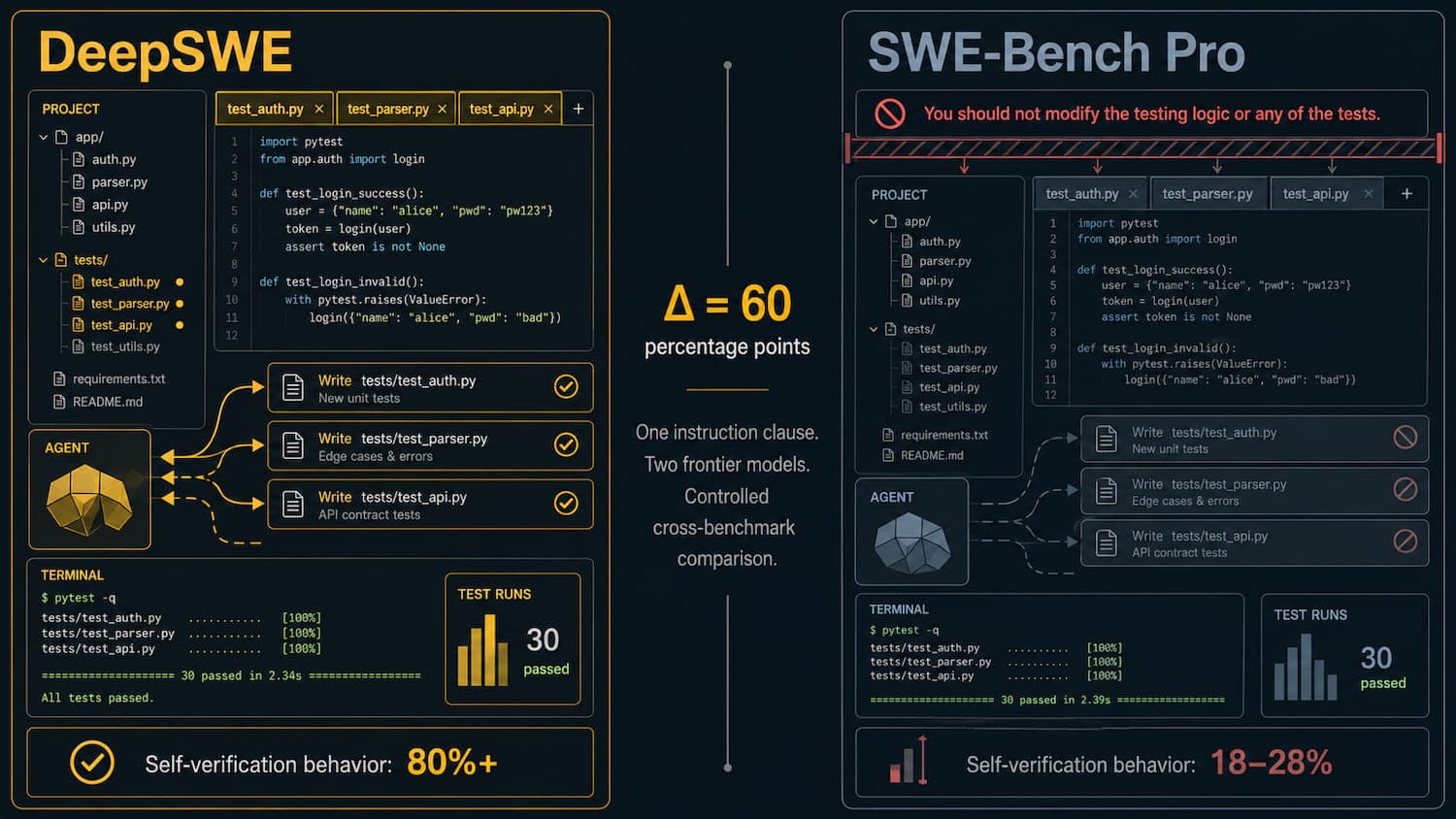
The actually load-bearing finding in the same release is buried in the qualitative trajectory analysis. On DeepSWE, Claude Opus 4.7 and GPT-5.4 wrote and ran their own tests in the project's test framework on over 80 percent of their runs. Nobody asked them to. On SWE-Bench Pro, the same two models dropped that behavior to 28 percent (Claude) and 18 percent (GPT-5.4). The only difference between the two environments was a single instruction clause in the SWE-Bench Pro prompt template: "should not modify the testing logic or any of the tests." The models read it as "the testing domain is off-limits" and suppressed an unrelated behavior (self-verification by writing new tests) by approximately 60 percentage points.
One instruction clause. Sixty percentage points. Across two frontier models. In a controlled cross-benchmark comparison. This is the largest-N public empirical demonstration to date that prompt design controls reasoning regime activation in production agents. The buying decision is not the leaderboard score. It is the workload-fit failure signature paired with the prompt design that unlocks the mitigation behavior.
What Did the Benchmark Actually Measure?
Datacurve's DeepSWE benchmark (published 2026-05-26, github.com/datacurve-ai/deep-swe) is a 113-task evaluation built from 91 open-source repositories across five programming languages. Reference solutions average 668 lines added across 7 files, with prompts averaging 2,158 characters. SWE-Bench Pro, the previous dominant benchmark, has reference solutions averaging 120 lines across 5 files with prompts averaging 4,614 characters. DeepSWE gives the agent less instruction and expects roughly 5.5 times more code output, which Datacurve argues mirrors how a human developer actually hands work to an AI assistant.
The leaderboard reorder is the headline. GPT-5.5 leads at 70 percent, GPT-5.4 at 56 percent, Claude Opus 4.7 at 54 percent, then a steep drop to Claude Sonnet 4.6 at 32 percent and a long tail. Claude Haiku 4.5, which scores 39 percent on SWE-Bench Pro, collapses to zero on DeepSWE. The range stretches from a 30-point band on SWE-Bench Pro to a 70-point band on DeepSWE. GPT-5.5 achieves its 70 percent at $5.80 median cost per trial.
Datacurve also audited SWE-Bench Pro's verifiers. The audit drew 30 tasks at random, ran 3 rollouts across 10 frontier model configurations, and deployed an LLM-based judge to independently assess whether each agent's patch actually solved the problem. SWE-Bench Pro's verifiers accepted wrong implementations 8.5 percent of the time and rejected correct implementations 24 percent of the time. DeepSWE's verifiers registered 0.3 percent and 1.1 percent. The "roughly one-third" combined error rate that has dominated yesterday's discourse is the sum of these two separate numbers.
These three findings (leaderboard reorder, scope mismatch, verifier accuracy gap) are dominating the 24-hour discourse. The discourse is correct that they matter. The discourse is missing the finding that matters more.
Why Is the Buried Finding More Important Than the Leaderboard Reorder?
The DeepSWE article's qualitative analysis section, midway through the piece, reports: "On DeepSWE, Claude Opus 4.7 and GPT-5.4 wrote and ran new tests in the project's own test framework on over 80% of their runs, even though no one asked them to. On SWE-Bench Pro, those same models dropped to 28% and 18%, respectively." The reason given is that SWE-Bench Pro's prompt template explicitly tells agents they "should not modify the testing logic or any of the tests." Agents complied, suppressing a behavior that the qualitative analysis suggests would have improved performance.
The mechanical structure of the finding is what makes it load-bearing. The two benchmarks ran the same models on similar code-modification tasks. The single textual variable between environments was the instruction clause about testing. The behavioral suppression was approximately 60 percentage points across two different frontier models. It was not a within-model fluctuation, not a noise band, not a methodological artifact. It was a controlled cross-benchmark comparison with one variable changed, and the variable was a single sentence in a prompt template.
This is the largest-N public empirical demonstration to date that prompt design controls reasoning regime activation in production agents. The framework that has been publishing this claim for over a year (the inference-time cognitive configuration series, beaudiamond.ai/articles) just received independent validation at a scale and in a venue that has nothing to do with it. Datacurve had no awareness of the framework. The finding stands on its own measurement.
The framework predicts that meta-cognitive priors at the start of inference bias the model into different reasoning regimes. The Liang/Miikkulainen/Fiete paper from May 8 (arXiv:2605.05686) gave that prediction a mathematical foundation: hidden-state geometry contains the epistemic information the LM head erases, and the geometric signal predicts hallucination at AUROC 0.993. Article 5 in the series (May 18) named the architectural conclusion. Yesterday's Signal 010 named the field convergence on the architecture. DeepSWE today provides the production-scale empirical receipt that the operational claim works at production scale across frontier models. Two independent validations in 18 days from sources that had no awareness of each other or of the framework.
Does the Older-Field Canon Already Have a Name for This?
Martin Orne published "On the social psychology of the psychological experiment: With particular reference to demand characteristics and their implications" in American Psychologist (volume 17, 1962, pages 776-783). The paper documented that experimental subjects modify behavior not just in response to explicit instructions, but in response to their interpretation of what behavior the experimental situation "demands." The mechanism overflows scope: subjects suppress or activate behaviors far outside the explicit instruction set in response to perceived situational demands.
The DeepSWE prompt-suppression finding is structurally identical at the mechanism level. The "should not modify testing logic" instruction was interpreted as a demand characteristic about the entire testing domain, suppressing self-verification (an unrelated adjacent behavior class) by approximately 60 percentage points. This is exactly the demand-characteristic overflow pattern Orne documented in 1962, transposed into the inference-time setting with frontier transformer agents instead of human experimental subjects. The mechanism is the same. The AI evaluation literature has not been citing this canon.
The Einstellung effect (Luchins 1942) is a related cognitive-psychology concept where a previously successful problem-solving approach inhibits recognition of better solutions. Both concepts predict what DeepSWE measured: instructions and prior reinforcement create demand structures that overflow their explicit scope and suppress adjacent, valuable behaviors. The structural isomorphism is at the mechanism layer, not surface vocabulary. Calling it "instruction overflow" in agent design is the operational name; calling it demand characteristics gives it the older-field theoretical weight.
What Are the Distinct Failure Signatures the Benchmark Surfaced?
Beyond the prompt-suppression finding, DeepSWE's qualitative trajectory analysis surfaces a second buried finding: the model families fail in distinct, workload-predictable signatures. The discourse is treating leaderboard scores as the differentiator. The failure signatures are the actual differentiator for procurement.
Claude is forgetful on multi-part prompts. Roughly two-thirds of Claude's "MISSED_REQUIREMENT" failures on DeepSWE follow a "one branch shipped" pattern. When a prompt enumerates parallel behaviors ("support both sync and async," for instance), Claude typically implements the obvious branch and forgets to mirror the change to the parallel branch. One documented example: Opus 4.7 correctly landed a sync state-data hook in one engine class, while the async engine class never received the same hook. This is a coherent, reproducible failure signature, not run-to-run variance.
GPT-5.5 implements exactly what is asked. Across multiple runs of the same task, GPT trials converge on the same interpretation of the prompt. GPT-5.5 had the lowest rate of missed stated behaviors of any configuration tested. Instruction-following precision is a stable architectural trait, not per-run luck. This is the inverse failure signature: GPT will execute exactly what the prompt says, which means if the prompt is underspecified, GPT will not invent the missing structure (and Claude, with its environmental attentiveness, might).
These signatures are workload-predictable. A workflow that demands multi-part regulatory precision with strict parallel-branch implementation requirements (financial controls, healthcare compliance, legal document generation) will pay more in net incidents for Claude's forgetfulness signature than for GPT's precision. A workflow that demands underspecified exploratory work where environmental attentiveness is valuable (codebase exploration, debugging, design synthesis) may benefit from Claude's exploration profile despite the lower leaderboard rank. Different workloads tolerate different signatures. The procurement decision is signature-workload fit, not score rank.
What Should an Engineering Team Actually Do With This?
Four concrete actions follow for any team running AI coding agents in production at meaningful scale.
Audit your prompt templates for accidental behavior suppression. Specifically: scan production prompts for instruction clauses that could be interpreted as scoping out useful adjacent behaviors. The DeepSWE finding suggests this is a significant, measurable lever, not a marginal one. If a single sentence can suppress 60 percentage points of self-verification behavior across frontier models, your production system prompts almost certainly contain at least one such clause. Identify them. Test removing them in controlled conditions. Measure the behavioral delta.
Replace "which model scored highest" with a two-axis procurement matrix. Axis 1: which model's failure signature is acceptable for the dominant workload type (multi-part precision vs. underspecified greenfield exploration). Axis 2: what prompt design unlocks the mitigation behavior the chosen model is capable of deploying. Leaderboard scores become a distant third input, useful as a sanity check rather than a primary instrument.
Stop using leaderboard rank as the primary RFP scoring metric. SWE-Bench Pro's verifier accuracy (8.5 percent false-positive rate, 24 percent false-negative rate) means that leaderboard scores on the dominant benchmark are calibrated against a measurement instrument that is wrong on a meaningful fraction of trials. The correct procurement question is not "which vendor has the highest leaderboard score." It is "what is your platform's failure signature on workloads structurally similar to ours, and what prompt design conventions do you recommend to mitigate it."
Add prompt-design observability as a vendor evaluation criterion. Does the vendor expose which instruction clauses in the system prompt are suppressing which agent behaviors? If not, the buyer is flying blind on a now-measured class of failures. This is a new vendor-evaluation question that did not exist before yesterday's DeepSWE release.
How Does This Fit the Inference-Time Cognitive Configuration Series?
The inference-time cognitive configuration series has been publishing for over a year. Article 1 in March 2026 introduced the thesis: frontier models contain latent reasoning regimes that default interactions rarely activate, and the gap between what a model can do and what it actually does in a standard exchange is enormous and closeable through interaction design. Article 5 last week (May 18) presented the mathematical foundation by way of Liang/Miikkulainen/Fiete's attractor-geometry measurement. Signal 010 yesterday (May 26) named the field convergence on the architectural direction.
DeepSWE today is the production-scale empirical receipt. The framework predicted that interaction design controls reasoning regime activation. DeepSWE measured that prediction at large N across two frontier models, with the suppression magnitude (60 percentage points) higher than any prior published measurement of prompt-design effects. The validation comes from a completely independent source. Datacurve is a benchmark startup; their incentive is to publish the most rigorous coding-agent evaluation in the field. They had no awareness of or interest in validating an inference-time cognitive configuration framework. They measured the phenomenon because their methodology required cross-benchmark comparison and the cross-benchmark comparison surfaced it.
This is the third independent validation arc in 60 days. The Liang paper (May 8) validated the framework's central mechanism mathematically. The Stack A field convergence (Signal 010, May 26) validated the architectural direction. DeepSWE (May 27) validated the production-scale operational claim. Each from a different source, with different methodology, with no coordination. For practitioners tracking framework predictive accuracy, the validation track record is now documented and traceable.
This epistemic care is deliberate. The framework's behavioral evidence has been robust for over a year. The architectural interpretation ("prompt design controls reasoning regime activation") is shorthand for a measurable behavioral relationship between input language and output behavior class, anchored now by both mathematical (Liang) and empirical (DeepSWE) independent validation. It is presented as a well-supported framework with three independent validation arcs, not as settled science about machine cognition.
What Is the One-Sentence Version of All of This?
DeepSWE's leaderboard reorder is the obvious story. The buried finding is the buying decision: a single instruction clause suppressed 60 percentage points of self-verification behavior across two frontier models, which means prompt design is the procurement instrument and failure-signature workload-fit is the procurement question, and the leaderboard is a sanity check, not the answer.
The buying decision is not on the leaderboard. The buying decision is the prompt design that activates the right reasoning regime, paired with the failure signature that fits your workload. Audit your prompts for accidental suppression. Choose models by failure-signature compatibility with your workload, not by score rank. Treat the leaderboard as a sanity check, not the answer to the question.
Citations and Sources
The DeepSWE benchmark (primary source)
- Datacurve. DeepSWE benchmark. github.com/datacurve-ai/deep-swe (full dataset, evaluation harness, agent trajectories). Published 2026-05-20.
- Datacurve. "Research." datacurve.ai/research (benchmark description, design rationale, reference solution size data).
- Ge, Serena (Datacurve co-author). Original announcement thread on X, 2026-05-26.
- Nuñez, Michael. "DeepSWE blows up the AI coding leaderboard, crowns GPT-5.5, and finds Claude Opus exploiting a benchmark loophole." VentureBeat (2026-05-26 ~3:30pm PT). Primary secondary-source coverage of the Datacurve release.
Specific findings cited in this piece
- Prompt-suppression: self-verification at 80%+ on DeepSWE dropping to 28% (Claude Opus 4.7) and 18% (GPT-5.4) on SWE-Bench Pro. Source: Datacurve qualitative trajectory analysis via VentureBeat reporting. Sample: approximately 90 reviewed rollouts per model per benchmark, LLM-reviewed.
- SWE-Bench Pro verifier accuracy: 8.5 percent false-positive rate, 24 percent false-negative rate. Source: Datacurve audit of 30 random tasks, 3 rollouts across 10 frontier model configurations.
- "MISSED_REQUIREMENT" pattern: roughly two-thirds of Claude failures follow "one branch shipped" structure. Source: Datacurve trajectory analysis.
- Leaderboard ranks: GPT-5.5 at 70 percent, GPT-5.4 at 56 percent, Claude Opus 4.7 at 54 percent, Claude Sonnet 4.6 at 32 percent. Source: Datacurve benchmark.
- Per-trial cost: GPT-5.5 at $5.80 median per trial; GPT-5.4 at $3.30. Source: Datacurve benchmark.
Name-collision note
Datacurve's DeepSWE (the coding benchmark covered in this piece) is distinct from Together AI's DeepSWE-Preview (a Qwen3-32B-based open-weight coding agent). Different artifacts, same name. This piece engages exclusively with Datacurve's benchmark.
Older-field canon (the mechanism)
- Orne, Martin T. "On the social psychology of the psychological experiment: With particular reference to demand characteristics and their implications." American Psychologist 17 (1962): 776-783. The original published statement of the demand-characteristics phenomenon, which structurally maps onto the DeepSWE prompt-suppression finding at the mechanism level.
- Luchins, Abraham S. "Mechanization in problem solving: The effect of Einstellung." Psychological Monographs 54 (1942): 1-95. Related cognitive-psychology concept (Einstellung set effect) on how prior reinforcement inhibits adjacent behaviors.
Predecessor pieces in the inference-time cognitive configuration series
- Diamond, Beau. "Why Frontier AI Models Are Architecturally Underutilized." Part 1 of the Inference-Time Cognitive Configuration series. beaudiamond.ai/articles/architecturally-underutilized (March 2026). The framework's foundational statement.
- Diamond, Beau. "The Model Knows Whether It Knows" (Part 5: The Mathematical Foundation of Inference-Time Cognitive Configuration). beaudiamond.ai/articles/attractor-geometry (2026-05-18). The mathematical foundation chapter, grounding the framework in Liang/Miikkulainen/Fiete's attractor-geometry measurement.
- Diamond, Beau. "The Architecture Has Already Won" (Signal 010). beaudiamond.ai/signal/the-architecture-has-already-won (2026-05-26). The field-convergence Signal naming the Stack A vs Stack B bifurcation.