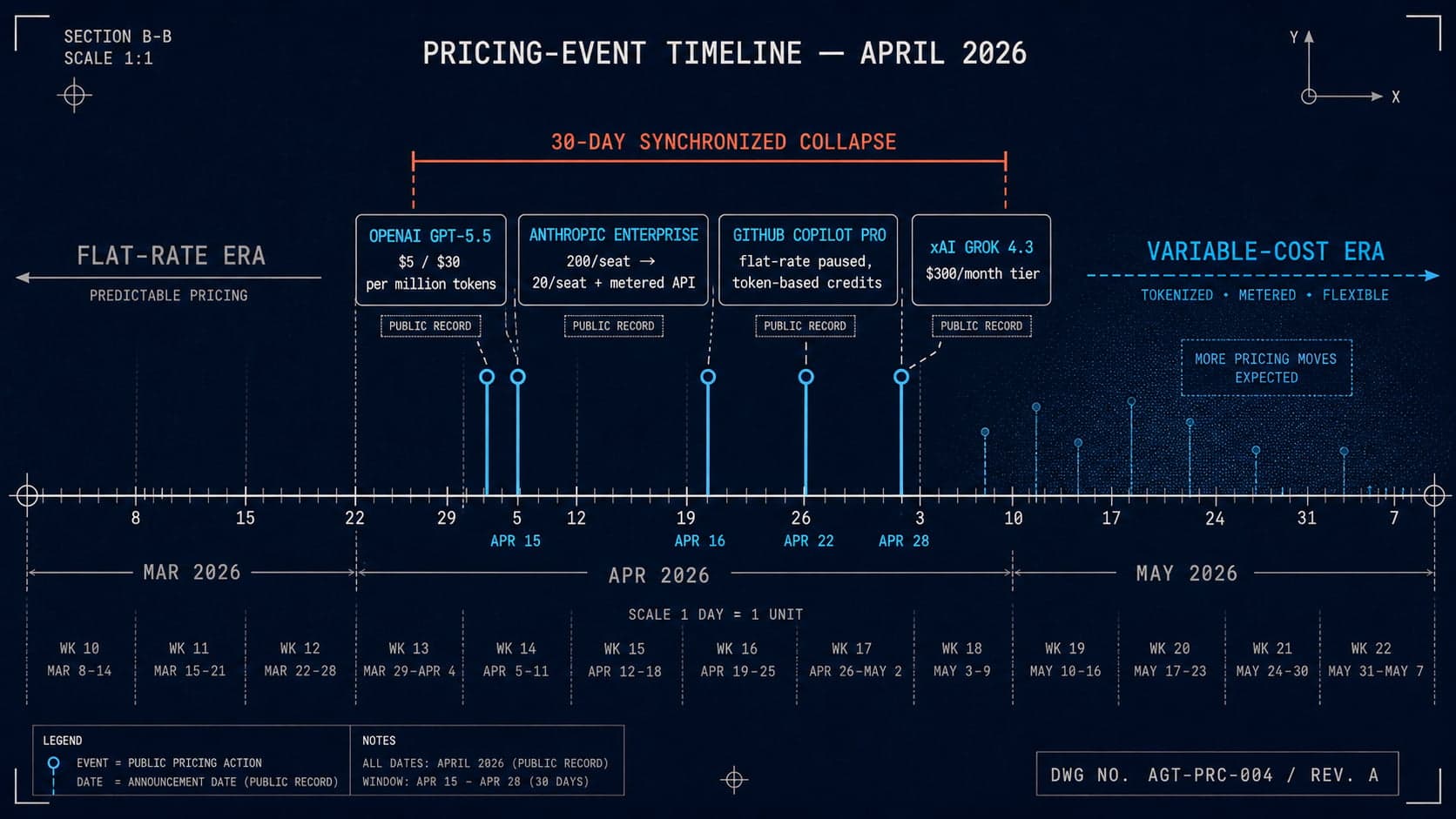
In a 30-day window between April 4 and May 2, 2026, four major AI labs ended flat-rate enterprise pricing. They moved the same direction. They moved at the same time. They are not in a position to coordinate.
Anthropic transitioned its legacy $200-per-seat enterprise plans to $20 per seat plus metered API on renewal. GitHub paused new Copilot Pro signups on April 22 and announced that flat-rate premium requests die on June 1, 2026, replaced by token-based AI Credits. OpenAI moved GPT-5.5 to $5 input and $30 output per million tokens. xAI launched Grok 4.3 behind a $300 per month tier. The Information reported on April 28 that "dozens of enterprise software firms have shifted away from charging flat per-user subscription fees" in the same window.
Four labs with very different market positions, ARR profiles, and investor expectations do not coordinate pricing. When the moves are this synchronized, the move is not a vendor strategy choice. It is the underlying compute economics surfacing through commercial terms that previously hid them. Flat-rate AI was an adoption subsidy. The subsidy is over.
The buyer-side response has not arrived yet. Atonement Licensing's review of 40-plus enterprise AI contracts signed during 2024 and 2025 found that the contractual primitives needed to survive a pricing-shape change of this kind are missing from almost every signed deal. Under 15 percent had usage audit rights. Under 10 percent had data-processing audit rights. Zero had model-change audit rights as a default term. The vendor side has moved. The deployer side has not. The window between those two moves is your buying advantage. It will close.
What The Next Bill Looks Like
Anthropic Managed Agents, announced April 8 and rolled out through mid-month, bills on three independent axes. Tokens consumed by the underlying model remain the first axis. The second is a session-hour runtime fee at $0.08 per hour the agent stays alive in the managed runtime. The third is per-tool fees triggered by built-in capabilities, the most cited of which is $10 per 1,000 web searches.
VentureBeat ran the math on a representative example: 10,000 customer-support tickets at roughly 3,700 tokens each works out to about $37 per run before runtime and tool fees are layered in. Three independent cost levers, each with its own scaling behavior, replace the single per-seat number that used to anchor the budget conversation.
Redress Compliance, in its published analysis of the Anthropic enterprise transition, estimates the move can triple costs for heavy Claude Code teams. The worked example: a 50-developer team running roughly $10,000 per month under the legacy flat-rate plan moves to between $25,000 and $30,000 per month under the new structure, depending on session duration and tool-call volume. The same team, doing the same work, on the same model. Only the contract shape changed.
This is not a price increase the vendor announced. It is an architecture change that converts token consumption from a fixed expense into the dominant variable in the line item. A CIO renewing an AI contract in May through September 2026 needs to assume the next bill is a different shape, not a different number.
Anthropic also pulled Claude Code from the $20 Pro plan as a "2 percent test" on April 22, reversed only after Simon Willison published the token math publicly the next day. The reversal is informative. The test is more informative. It tells you which direction the unit economics push when a vendor is trying to find the new floor.
The Salesforce data point names the shape of what is happening on the other side of the contract. Jason Lemkin reported on April 26 that Salesforce customers are reducing seat counts but spending 83 percent more per account because of AI usage. Notion is seeing the inverse on the seat side, with less need and fewer seats. ICONIQ's State of Go-to-Market 2026 reports 48 percent of companies now use hybrid pricing as their primary model and 85 percent of SaaS leaders have adopted usage-based or hybrid pricing in some form. SAP officially shifted from per-user to consumption-based pricing in direct response to AI agents automating workflows.
The cost is not falling. It is rerouting from per-seat to inference. CFOs assuming AI will produce SaaS savings are getting a different bill, not a smaller one. CIOs assuming they can swap models in a week are wrong on the inverse: once the price has rerouted to inference, switching means rebuilding the workflow.
The Audit-Rights Gap
Atonement Licensing's audit is the load-bearing piece of evidence here. They reviewed more than 40 enterprise AI contracts signed in 2024 and 2025, drawn from named buyers across financial services, retail, healthcare adjacent operations, and enterprise software. The pattern was consistent enough to publish.
Under 15 percent of the audited contracts had usage audit rights. Under 10 percent had data-processing audit rights. Zero had model-change audit rights as a default term. Atonement's framing on the gap: "These are not exotic protections. They are standard governance requirements that AI vendors have not yet normalized into their commercial terms. The absence is systematic, not accidental."
This is the audit-rights gap: the structural mismatch between the pricing and product changes vendors are now making and the contractual primitives the deployer side did not insist on when those contracts were signed. It is the procurement-audit equivalent of a balance-sheet debt that no one booked.
Three clauses are now table-stakes on any AI contract a CIO or CFO signs. Almost no signed contract has them.
The first is a model version pin with a 60-to-90-day change notice and a rollback path. GPT-4 in May behaves differently from GPT-4 in March. Claude 3.7 in April is not Claude 3.7 in October, even when the public model identifier is unchanged. A validation run that passed three months ago is not a valid attestation today unless the contract explicitly pins the model version under which the validation occurred and gives the deployer notice and recourse before that version changes underneath them. Twenty-four months ago this clause was not standard. Today its absence is a silent liability.
The second is a token-rate MFN, indexed to the vendor's published API rates. Opus pricing dropped 67 percent over the 2024-2025 window as the model line moved from 4.1 to 4.6. Without an MFN, a committed-spend agreement signed at the higher rate is locked above market for the duration of the term. The deployer who signed early absorbs the entire benefit of the price decline by default; the vendor captures it. The MFN clause flips that default.
The third is IP indemnity for generated output. Google, Microsoft, and IBM all offer this as a standard contractual position when their models or platforms produce content the deployer ships. Most AI-native vendors do not. The deployer carries the full liability for output errors, infringement claims, and downstream copyright disputes unless the indemnity is explicit. @TheSebBlack walked through the indemnity-clause asymmetry on April 28; the divergence between hyperscaler defaults and AI-native defaults is the single largest unbooked risk transfer in the category.
The asymmetry is not accidental. Vendors did not normalize these terms because they have no incentive to. The deployer has to bring them. CFOs and General Counsel reading 2024-25 AI contracts as if they were SaaS contracts are systematically mispricing the risk on the deployer side of the deal.
The April 30 piece in InformationWeek, written in the wake of the Google-Pentagon AI deal disclosures, named the same three categories from a slightly different angle and added the procurement framing: deployers should expect to redline every renewal cycle from May 2026 forward, refuse to sign without the three clauses present, and pull the existing contract portfolio for a gap audit before the renewal calendar reaches them.
The Portability And Exit Gap
InformationWeek's April 30 analysis named a fourth gap that sits adjacent to the audit-rights gap but is structurally distinct: portability of prompts, workflows, and embeddings on exit. Most enterprise AI contracts signed in 2024 and 2025 do not contain a clause specifying what the deployer leaves with when the relationship ends.
Without a portability clause, "switching vendors" does not mean migration. It means rebuilding. The prompts, the chained-tool wiring, the eval suites, the embeddings indexed against the vendor's specific encoder, the retraining data the deployer accumulated inside the vendor's environment: none of that is guaranteed to come out unless the contract says it does. The cost of leaving is the cost of the build, not the cost of moving.
This is the kind of gap that does not surface until the deployer tries to leave, at which point the leverage has already collapsed. Add a portability clause to every renewal. Specify the artifacts in writing. Specify the formats. Specify the export window and the destruction terms. The clause is cheap to negotiate before signing and effectively impossible to negotiate after.
The Insurance Gate
On February 11, 2026, ElevenLabs became the first company on record to bind underwritten AI agent insurance against a published certification standard. The standard is AIUC-1, developed in part with Munich Re. The coverage limit is up to $50 million for hallucinations, brand harm, data leakage, IP infringement, and tool-action failures including incorrect refunds and unauthorized purchases.
AIUC's stated customer roster as of late 2025 includes ElevenLabs, Cognition, Intercom, and Ada. The Ada deployment is the operational tell. According to AIUC's published case material, Ada used AIUC-1 to unblock a deployment with one of the world's largest social-media platforms, where the procurement team had refused to advance the agent into production without an insurance backstop. The certification was not marketing. It was the artifact that closed the contract.
The AIUC-1 testing breadth is the part that gives the certification weight. Audited deployments are tested across 5,835 adversarial simulations spanning 14 risk categories before the policy binds. That number is published. It is not a description of what could be tested. It is the threshold that separates "AIUC-aligned" from "AIUC-1 certified."
The carrier landscape around AIUC is broader than AIUC alone. Munich Re's aiSure product has been active since 2018 as a parametric coverage option for model performance shortfalls. Armilla underwrites through Lloyd's as a coverholder with a focus on AI model warranty. Testudo offers litigation defense specifically for AI deployers. AIUC bundles assurance and insurance into a single procurement-facing artifact. As of May 2026, these four lines are the practical universe of AI-specific coverage available to enterprise buyers.
In parallel, the existing E&O and cyber market is moving the other direction. ISO endorsements CG 40 47 and CG 40 48 have been added to the available exclusion library and are being applied at renewal: they remove AI from coverage that previously included it by silence. Affirmative AI products in the European market are slated to come online in Q3 2026. The transition window for enterprises is the period in between, during which existing AI deployments may be quietly stripped of coverage at the renewal of a policy the deployer assumed was carrying that coverage.
The buying decision has shifted. It is no longer "do I trust this AI vendor." It is "is this vendor AIUC-1 certified or carrying equivalent reinsurer-backed coverage, what does my E&O renewal say about AI in writing, and do I have a 6-week certification path on the critical path before go-live?"
The thinkpiece version of this story is "AI liability is coming." The signal-grade version: it arrived in February, the first bound deployment is named, the certification standard is published, and the procurement gate is forming now. Enterprises that do not add a "vendor must hold AIUC-1 or equivalent" clause to their AI RFPs starting in May 2026 will find themselves uninsurable on those deployments by Q4 of the same year. The early-mover window before AIUC-1 or its equivalent becomes table-stakes RFP language is on the order of nine months.
The CPO-CIO Procurement Seam
The dominant tier-two narrative on AI deployment failure has been "the model is not ready for production." The supplementary signal-grade reread, traced across three independent practitioner posts in the same window, is sharper than that. The model is fine. The procurement process is what is failing.
@the_zero_index, in three posts spanning April 27 through April 30, 2026, named the precise mechanism: procurement sets commercial terms while IT owns control implementation, and those timelines diverge after the demo. If contract milestones close before control owners are assigned, pilots ship but production rollout stalls. The CPO and the CIO measure success on different timelines, sign different sides of the contract, and do not reconcile until the pilot is already in production limbo.
The same thread surfaced two adjacent procurement failure modes. The first is vendor-default-change risk: a tool can flip a data-use policy at renewal or release without the deployer-side control owner being notified, because the control owner is not a contract counterparty. The second is critical-infrastructure mapping: approvals stall when architecture evidence is weaker than the policy language the contract attached, because policy was negotiated before the architecture review the policy assumed.
christiannonis published the supporting statistic on May 2, 2026, in a stat block that became the most-cited single procurement post of the week. 88 percent of enterprise AI pilots fail to reach production. Of those failed pilots, 73 percent had no pre-launch success metrics defined as a contractual deliverable. 80 percent of Q1 2026 enterprise software embeds an agent. 31 percent of those agents are running in production at all.
That 88-percent number gets cited as a model-readiness statistic. It is increasingly a procurement-discipline statistic riding under an AI label. You do not fix the 88 percent by buying a better model. You fix it by aligning the CPO-CIO sign-off timeline before contract milestones close and by requiring pre-launch success metrics as a contractual deliverable.
Zowie's April 29 piece on enterprise buying-committee discipline names the operational shape. The 2026 enterprise AI shortlist passes through six gates: procurement, security, legal, engineering, customer experience, and finance. Each gate has independent veto authority and an independent timeline. Zowie's framing is that the 2026 shortlist is three to five platforms passing all six gates, not ten platforms passing four. Allianz, working from the six-gate framework, took an AI deployment from pilot to live in under six weeks. The Allianz case is the counter-example that names the upside: when the buying committee has the framework and the platform is architecturally mature on the dimensions the gates measure, time-to-live compresses from the typical six-to-nine-month range into the six-week range.
Why Now
The capital-side picture explains why the vendors moved when they did. Cast AI's enterprise compute report, referenced in the Radical Data Science April 2026 bulletin, found that 95 percent of enterprise compute sits idle on average. That number is concurrent with frontier-lab GPU hoarding and with cumulative AI infrastructure investment crossing $1 trillion.
95 percent idle is the load-bearing market-structure data point of the quarter. The conventional read on the AI capital flows is that demand is finally catching up with supply. The Cast AI number says the opposite at the deployment edge: the paid compute already provisioned by enterprise buyers is mostly not being used, and the labs are still hoarding the next layer of capacity. The capital is funding optionality on hyperscaler compute access, not enterprise demand that is currently materializing.
OpenAI reportedly missed its Q1 2026 revenue and user targets and is projecting roughly $14 billion in losses for the period. The CFO has reportedly questioned whether the company can fund its compute commitments at the projected trajectory, and the $852 billion valuation needs that trajectory to clear. Anthropic, at $14 billion ARR, has Google's $10-to-40 billion incremental investment structured as contingent on hitting forward growth targets at a $350 billion post-money mark, down from earlier reporting of $380 billion.
Crunchbase Q1 2026 venture funding data names the asset-class shift: AI absorbed $242 billion of venture capital in the quarter, 80 percent of total global VC. The same number for Q1 2025 was 53 percent. Forty deals announced funding of $500 million or more, consuming $482 billion in committed capital, which is 94 percent of total dollars across the AI category. 135 deals in the $20-to-50 million range pulled $4.2 billion, roughly 1 percent. Bifurcation, not distribution.
The late-stage AI capital is conditional on consumption that is not happening yet. Vendor leverage is overstated by valuation. The buyer's negotiating window in May through September 2026 is real and time-bound. The vendor needs the contract more than the buyer needs the vendor in this window. Push for the clauses that the vendor's growth narrative would normally make them reject.
The Buying Posture For The Next 30 Days
Most CIOs read this and think "I will handle it at next renewal." That posture costs you the window. Anthropic's enterprise customers were silently transitioned to consumption billing starting in November 2025. The first many of them noticed was when the April 2026 invoice arrived. The vendor side has already moved. Six concrete actions follow.
Audit existing 2024-25 AI contracts for the three clauses. Pull every AI vendor contract signed in the last 24 months. Run a gap analysis against model version pin, token-rate MFN, and IP indemnity. Most will be missing all three. Stack-rank by annual spend and by criticality of the workload. The contracts at the top of that list are the ones to prioritize for renegotiation outside the standard renewal calendar.
Redline every contract on next renewal. The three clauses go in the redline by default. So do per-seat-month spend caps, per-session runtime caps, and a notice-and-rollback clause on any vendor-initiated default change. The vendor's first response will be that these are not standard terms. They are standard at Google, Microsoft, and IBM. They are standard at the companies whose contracts the deployer's General Counsel respects. Hold the line.
Re-budget AI line items as variable-cost runtime, not per-seat SaaS. The 2026-27 budget cycle should classify AI spend on the same line as cloud infrastructure, not on the line as software subscriptions. Forecasting variance is wider. The CFO needs to see a band, not a number. Require any enterprise SaaS vendor whose product now embeds AI to provide a 12-month historical usage trajectory and a worst-case runtime ceiling before the contract closes.
Audit E&O and cyber policies for AI exclusions before the next renewal. The CG 40 47 and CG 40 48 endorsements are being added quietly. Read the actual policy language. If the language says AI is excluded, the deployer is uninsured on every AI workload regardless of what the vendor's own indemnity says. The fix is to pull AIUC-1 certified vendors onto the procurement shortlist, add affirmative AI coverage as a board-level briefing item, and make AI insurance a procurement-gate decision rather than a procurement footnote.
Add AIUC-1 or equivalent to AI vendor RFPs from May 2026 onward. The certification path takes weeks. Building the requirement into RFPs now means the vendor either produces the certification or is pushed off the shortlist. Both outcomes work for the deployer.
Restructure the procurement workflow to require named control-owner assignment as a contract milestone. This is the CPO-CIO seam fix. The control owner is named in writing before commercial terms close. Pre-launch success metrics are written into the contract as a deliverable. The Allianz example is the proof point that this compresses time-to-live; the @the_zero_index thread is the diagnostic that names what happens when it does not.
The vendor side has moved. The deployer side has not. The buying advantage is in the gap. Use the next 30 to 90 days to close it before the gap closes on you.
Citations and Sources
Vendor pricing and category shift
- IQ Source. "The flat-rate AI era ended this week." May 2, 2026. (Synchronization thesis across Anthropic, OpenAI, GitHub, xAI.)
- The Register. "Anthropic enterprise pricing transition." April 16, 2026. ($200/seat legacy plans transitioned to $20/seat plus metered API on renewal.)
- VentureBeat / Finout. "Anthropic Managed Agents pricing." April 8-12, 2026. ($0.08 per session-hour runtime; $10 per 1,000 web searches; 10,000 tickets at 3,700 tokens = $37 per run worked example.)
- Redress Compliance. "Anthropic 7-clause guide and cost analysis." 2026. (50-developer team moves from ~$10K/month to $25,000-30,000/month under the new structure.)
- The Information. "Dozens of enterprise software firms have shifted away from per-user subscription fees." April 28, 2026.
- @jasonlk (Jason Lemkin) on X. April 26, 2026. (Salesforce: reduced seat counts, 83% higher spend per account.)
- ICONIQ. "State of Go-to-Market 2026." (48% of companies report hybrid pricing as primary; 85% of SaaS leaders on usage-based or hybrid.)
Audit-rights and contract gap
- Atonement Licensing. "Enterprise AI contract audit, 40+ deals signed 2024-25." Cited March 2026. (Under 15% with usage audit rights; under 10% with data-processing audit rights; zero with model-change audit rights.)
- InformationWeek. "AI contract gaps the Google-Pentagon deal just made visible." April 30, 2026. (Three audit categories plus the portability and exit gap.)
- @TheSebBlack on X. April 28, 2026. (IP indemnity asymmetry between hyperscalers and AI-native vendors.)
- @JTillipman on X. May 1, 2026. (Data rights and vendor refusal rights.)
Insurance and certification
- ElevenLabs / AIUC announcement. February 11, 2026. (First bound AI agent insurance against a published certification standard; AIUC-1 with Munich Re participation; up to $50M coverage; 5,835 adversarial simulations across 14 risk categories.)
- Klaimee. "AI agent insurance: what enterprise procurement now requires in 2026." May 1, 2026.
- Gallagher Re. "Smart Systems, Blind Spots." March 2026. (Carrier landscape, ISO endorsements CG 40 47 and CG 40 48, affirmative AI products Q3 2026.)
- Insure Your Agent directory. April 25, 2026 omnibus update. (Carrier and certification roster: Munich Re aiSure, Armilla, Testudo, AIUC bundle.)
Procurement seam and pilot-to-production
- @the_zero_index on X. April 27 through April 30, 2026. (CPO-CIO seam mechanism; vendor-default-change risk; critical-infrastructure mapping.)
- christiannonis on X. May 2, 2026. (88% pilot-to-prod failure; 73% without pre-launch success metrics; 80% of Q1 2026 enterprise software embeds an agent; 31% in production.)
- Zowie. "Enterprise buying-committee in 2026." April 29, 2026. (Six-gate framework; Allianz under-six-weeks-to-live counter-example.)
- @advikjain_ on X. May 3, 2026. (Demo-versus-production gap from the deployer side.)
Capital structure and market signal
- Cast AI. Enterprise compute report referenced in radicaldatascience April 2026 bulletin. (95% idle compute on average across enterprise deployments.)
- The Information. "OpenAI Q1 2026 revenue and user shortfall." April 28, 2026. ($14B projected losses; CFO commentary on compute commitments.)
- Crunchbase. "Q1 2026 venture funding analysis." (AI = $242B / 80% of global VC; 40 deals at $500M+ consuming 94% of dollars; 135 deals at $20-50M pulled 1%.)
Prior Signal in this series
- Diamond, Beau. "The Routing Failure." beaudiamond.ai/signal/routing-failure. May 4, 2026.
- Diamond, Beau. "The Supervisory Signal Layer: Why Every Hyperscaler Just Shipped the Same Thing." beaudiamond.ai/signal/supervisory-signal-layer. May 1, 2026.
- Diamond, Beau. "The Cognitive State Layer." beaudiamond.ai/signal/cognitive-state-layer. April 30, 2026.